Case study 01Built, pilot next
Markelo
Giving lecturers their time back.
- Role
- Product Design Lead
- Timeline
- July 2026 to now
- Platform
- Web app, desktop and tablet
- Field
- Education
- Team
- The founder and 18 volunteers, including a design team of 9 that I led
Paper exams leave a thin trail, and lecturers spend their time marking instead of researching. I lead product design on Markelo, which gives them that time back: one record from script to result, with the name hidden.
The short version
BeforeA marker sees the student's name on the cover of a paper script.
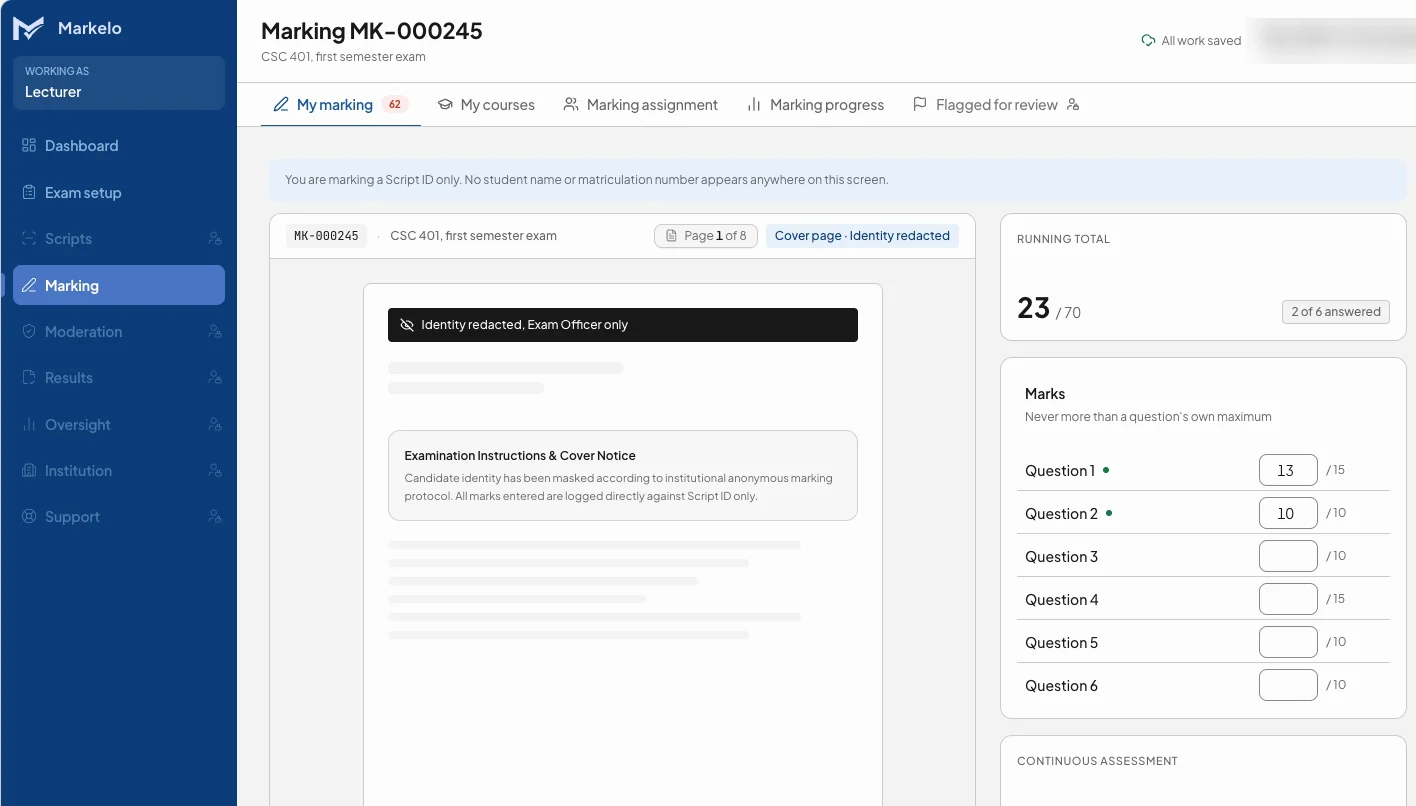
AfterA lecturer marks a Script ID such as MK‑000245. The name stays off the screen.
BeforeOne script added up to 100 in one view and 90 in another.
AfterCoursework 30 plus exam 70 by default, so every view shows the same 100.
BeforeEvery role saw every link, with a padlock on the ones it could not open.
AfterEach of six roles sees only the pages it can use.
- My part
- Joined in July 2026, Product Design Lead from August 2026. I ran field research with the founder and directed the audit, the marking and navigation redesigns, and the handover. AI coding sessions built each change; I reviewed every one.
- Outcome Not measured yet
- Built and deployed: about 155 screens and two private repositories, delivered to the build teams on 2 November 2026. I still lead the product and now work on it as a product engineer while Markelo raises money. No live exam has run yet, so there is no usage data. Next is a pilot: one course, one exam period.
Calls I made
- 01
Mark by question across scripts, inside the marking screen.
The founder asked to mark all the Q1s, then all the Q2s. Of the two places it could live, I picked the marking screen over the answer viewer.
- 02
Fix the split at coursework 30 and exam 70 by default.
One script added up to 100 in one view and 90 in another. A fixed default makes every view agree. The handover notes flag that the requirements do not set it.
- 03
Give each of six roles only the pages it can use.
I approved nine navigation decisions from a table of sources, for example no Reports for the Officer, Lecturer or Moderator. One still waits on the founder.
- 04
Build a Reports screen the plan had left for version two.
The Reports tab was already in the menu with nothing behind it.
- 05
Cut the exam performance view to six cards.
Scanning, ingestion and the defensibility index came out. The view is for the vice-chancellor's office, and those three did not answer its questions.
- 06
Hand over in three parts across two private repositories, and hold the push until the team and the founder had talked.
Design system, front end and back end, on my own GitHub so the work shows product engineering. The design system stays internal.
Paper exams leave a thin trail.
Exams in Nigerian universities and polytechnics still run on paper. Scripts move from the hall to the marker with no record. Markers can see the student’s name. Lecturers re-type marks into spreadsheets, so disputes are hard to settle. In 2025, students at OAU found marked scripts with a roadside vendor before results were out (reported by Premium Times).
Lecturers mark more than they research. Lecturers at public institutions told the team they each mark about 1,000 scripts a semester.
Markelo runs one chain from script to result. Staff scan the script, Markelo codes it so the name is hidden, a lecturer marks it, a second examiner checks it, and the results go out once confirmed. Every step goes into a record nobody can quietly change. Lecturers do all the marking. AI-assisted marking is planned as an option, and the lecturer decides.
“You are the owner of the grading. AI is not the owner, so you cannot allow AI to grade for you.”
We listened first: from four conversations to 38.
In July the founder told the team we had spoken to about four people, and that the next step was evidence, not more screens.
In August she and I took Markelo to two campuses. One university wanted formal letters to officials and gave no time for an answer, so we went straight to lecturers and staff during the exam period. One assumption the team had marked as unproven, that institutions already own bulk scanners, got its first real answer: the ICT unit at one university said scanners were not a barrier, because it already had similar equipment.
By the pitch, the team had interviewed 38 people at 5 institutions: lecturers, exam officers, IT staff, heads of department and deans.
“The lecturer has to mark the script very well. Because any student can write so and say that their script is not marked properly.”
The tablet broke, and nobody saw it for seven weeks.
The audit scored the build 8 out of 10 before fixes and 9 after. That score is a check against our own plan, not a test with users, so I treat it as a to-do list rather than a result.
The marks did not add up to 100.
One script was out of 100 in one view and 90 in another, while the grading rule says coursework is worth 30 and the exam 70. I raised it, and we fixed the exam at 70 marks by default, so every view adds up to the same 100.
“At times you mark scripts, you have to then cross-check and then sort the scripts, then enter the result like in an Excel sheet and then you compute.”
Every role sees only its own doors.
Six roles use Markelo: Exam Officer, Lecturer, Teaching Assistant, Moderator or Head of Department, Institution Admin and Senior Management. The first menu showed every link to everyone, with a padlock on the ones a role could not open.
Not this
Every link for every role, locked ones greyed out with a padlock
Half the menu was doors a person could not open. Each role's real work was harder to find, and the menu advertised screens they had no reason to know about.
This
Each role sees only the links it can use, plus Settings and Help
The menu becomes a map of one person's job. Nine rules then set what each role gets: for example, the Exam Officer sees the audit trail for their own exams only.
The team made the call on 17 October, and I signed off the nine role rules the same day.
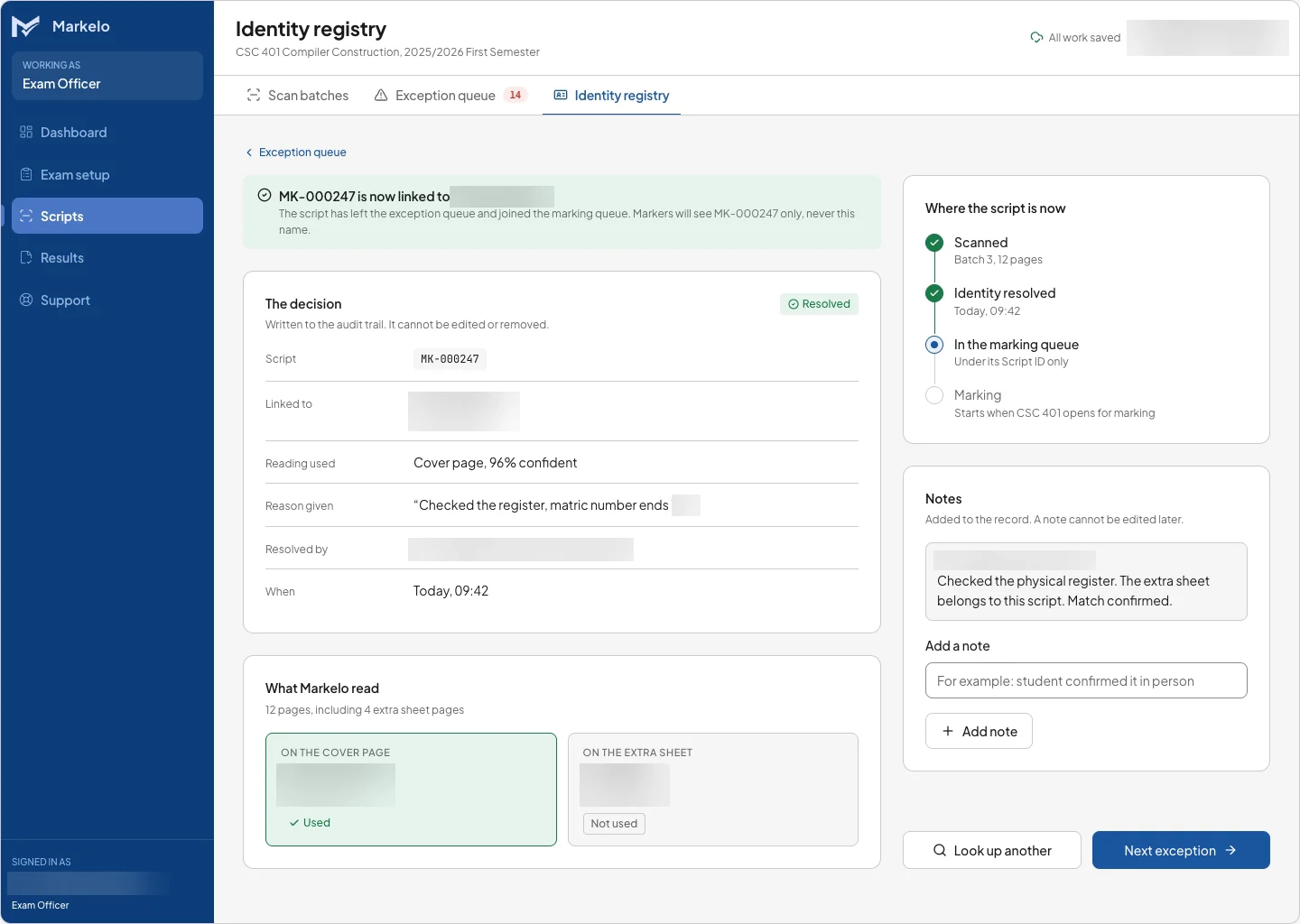
Only the Exam Officer links a script to a name, and that decision is written to a record where notes can be added, never edited or removed. Names and matric numbers are blurred here.
Marking question by question.
The founder asked, by voice note, for a way to mark every answer to Question 1, then every answer to Question 2, across all the scripts. I put it in the marking screen rather than the answer viewer. It took five review rounds: the toggle bounced on every click, the corner radii were off, and the buttons were 40 pixels tall on a page built on 42.
The toggle switches the whole screen to one question across every script, and the button says exactly what comes next: Question 1, next script. Sound removed; names blurred.
Build noteAI sessions wrote the code. I directed each one and checked the result.
AI coding sessions, mostly Claude, wrote the code. I set each task, reviewed the result on screen, and decided what shipped.
What only the running build could tell us: the missing tablet rail, which no document mentioned; a checkbox edge at 1.61:1 contrast against a 3:1 rule; and a tablet artboard that matched a true 768-pixel view exactly, 0 of 786,432 pixels different. At the handover, scripts checked navigation, button actions and modal fit across the prototype.
What changed
On 2 November I split the work into three parts, the design system, the front end and the back end, and delivered the front end and back end in two private repositories. The handover guides went from 7,176 words to 5,591, and from 2,234 to 1,229. Before anyone read them, we checked 177 of their claims against the build: 144 held up, and we listed the rest.
Markelo is built and deployed. No live exam has run yet, so there is nothing to measure. Next is a pilot: one course, one exam period. Then I would measure the time to mark one script and the share of scripts marked with no name in view.
Looking back
I asked for a Reports screen that the current plan had moved to version 2, and the team built it from an older plan. Next time I check the project’s list of current documents before I ask for a screen. With two more months, I would transcribe the interviews recorded at the third campus and test the marking flow with five lecturers.
Credits
The founder set the product and its research direction. A second designer led design before me and set up the design system foundations and the first prototype. The front-end and back-end teams build from what we delivered.